When the Green Paper was subsequently published, I welcomed the focus on getting people into work as the best way to improve people’s lives, as well as to grow the economy. At the same time, I welcomed action to reduce the spiralling welfare bill that is simply unsustainable without action
The Bill also uprates Universal Credit so that people have more money in their pockets.
However, I was far from satisfied with all of the proposals and felt many lacked the detail required for me to support them.
I highlighted three specific concerns at the time:
- People unable to work should not be subject to needless, demeaning and punitive assessments or measures. I believed “right to try” was a vital part of any proposed changes as a way of supporting people in to work by creating a safety net which would not leave anyone financially disadvantaged for trying a job that didn’t work out.
- I was concerned there would no longer be a health top-up in Universal Credit for under 22s.
- I wanted more clarification on “increased expectations to engage with claimants” and what this would mean in practice to support people in to work.
In addition, I have heard clearly that proposals around PIP payments have been a key area of concern. In Scotland, PIP is devolved and called the Adult Disability Payment (ADP), fully within the control of the SNP Scottish Government. The Social Security Scotland agency are also considering reviewing ADP criteria which could include a “lower rate of adult disability benefit” in order to “have a positive impact on the public finances in the medium to longer term.”
Navigating the balance between the right support for those who need it, and ensuring the welfare support system is sustainable for generations to come, remains a universal challenge for governments to consider and I understand why the government has indicated this afternoon, their intention to pause any changes on PIP eligibility until after the review being led by Minister Stephen Timms.
Under the SNP in Scotland, economic inactivity rate is higher than the rest of the UK with 133,800 of Scots currently economically inactive but want to work. In government, the SNP have cut employability schemes for disabled people and failed a generation, with 1 in 6 young people in Scotland not in work, education, or training.
So, while the UK government seeks to make changes that are difficult and not popular, I would ask constituents to be aware of political manoeuvring and misinformation coming from others looking to blame others for things they too are considering.
After the publication of the Green Paper, I held events in the constituency that were vital in building my understanding of how people engaged with DWP and, in particular, how broken the current system really was and how much it needed to be reformed. I want to thank everyone who took part in the sessions or who wrote to me separately.
A key learning from those events was that the UK government had made a major error by appearing to focus the proposed changes on money and not on people. This made it much harder for people to trust the government’s motives and priorities.
As I said at those sessions and have said so publicly, I could not agree more. Welfare reform, while difficult and critically needed, should always begin with people, even if there is a necessity to also consider public spending in the long term while undertaking reform.
Prior to the publication of the legislation, I had numerous meetings with Ministers, Special Advisers and other MPs, as well as hearing from third sector and charity bodies.
When the Universal Credit and Personal Independence Payment Bill was finally published on 18 June I was dismayed. It had not taken account of the improvements suggested by colleagues and neither were there the additional detail or reassurances I felt was needed for me to support the legislation.
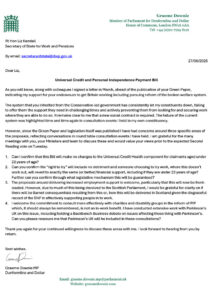
After further meetings and discussions, along with changes announced to the legislation, I wrote again to the Secretary of State, Liz Kendell, on Friday (27 June) asking for specific reassurances on four key points that have evolved from my first concerns. The full text of the letter is included below but the points I asked for clarification about were:
- Confirmation the Bill makes no changes to the Universal Credit Health component for claimants aged under 22 years of age.
- The “right to try” will include no detriment and someone choosing to try work will revert to exactly the same (or better) financial support
- Clarity on how increased employment support will be delivered, particularly given elements of this are devolved to the Scottish Government.
- Emphasising that PIP is not an in-work benefit and asking that, in the reform of PIP, Parkinsons UK, with whom I have done a considerable amount of work, be included. This is particularly important as one of a number of groups representing people with variable conditions.
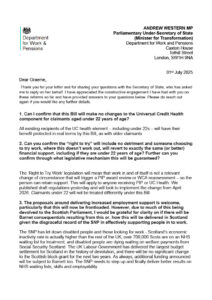
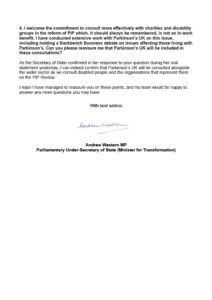
The full text of the reply from the Minister for Transformation on behalf of the Secretary of State is below but her responses are:
- All existing recipients of the UC health element – including under 22s – will have their benefit protected in real terms by this Bill, as with older claimants
- The ‘Right to Try Work’ legislation will mean that work in and of itself is not a relevant change of circumstance that will trigger a PIP award review or WCA assessment – so the person can retain support. This will apply to anyone receiving PIP or UC Health. We published draft regulations yesterday and will look to implement the change from April 2026. Claimants under 22 will not be treated differently under this Bill.
- The SNP has let down disabled people and those looking for work – Scotland’s economic inactivity rate is actually higher than the rest of the UK, over 700,000 Scots are on an NHS waiting list for treatment, and disabled people are dying waiting on welfare payments from Social Security Scotland. The UK Labour Government has delivered the largest budget settlement for Scotland in the history of devolution , and there will be no significant change to the Scottish block grant for the next two years. As always, additional funding announced will be subject to Barnett consequential funding. The SNP needs to step up and finally deliver better results on NHS waiting lists, skills and employability.
- I can confirm that Parkinson’s UK will be consulted alongside the wider sector as we consult disabled people and the organisations that represent them on the PIP review.
As a result of the assurances and changes given by Ministers to the most immediate concerns raised by my constituents, I felt able this evening to vote for the Bill at Second Reading.
While this vote signals my approval of the general principles of the Bill, I believe the proposed legislation is far from perfect. This evening, I have tabled an amendment which seeks to expand the definition of “severe conditions criteria” to include those whose conditions fluctuate, for example Parkinson’s and Multiple Sclerosis.
I am also angry with the process by which we have reached this stage. It has made disabled people and those relying on welfare support fearful and angry. That is not and never will be acceptable to me. Senior members of the government must reflect on that and ensure that we rebuild trust with those groups who also want to see the effective reform of a broken welfare system.
I do not believe that this process has embodied the Labour values that we were elected on just a year ago.
I know my decision to vote as I have this evening will anger some people and I fully accept that. I hope my explanation above helps explain how I reached this view.
My letter to Secretary of State Liz Kendall
The reply to my letter from the Minister for Transformation
Recent Comments